

5 Years, 9 Months in Orbit: What LDEF Taught Us About Silver Teflon Tape
- 23 hours ago
- 7 min read
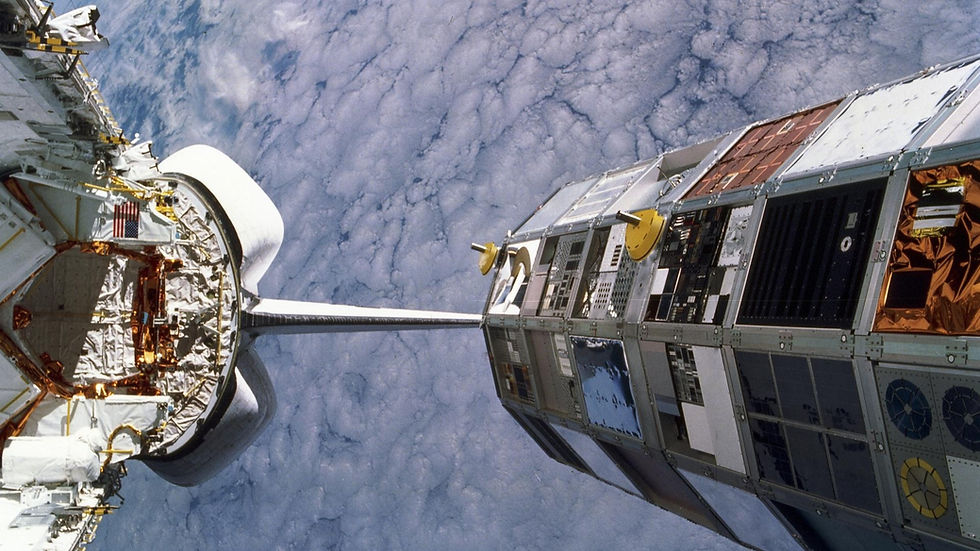
NASA Long Duration Exposure Facility (LDEF)
In 1984, NASA launched a 14x30 ft payload from Space Shuttle Challenger with one purpose: leave it in space, come back later, and see what happened. What they retrieved nearly six years later became the most valuable dataset in spacecraft materials history.
The Long Duration Exposure Facility (LDEF) was deployed by Space Shuttle Challenger STS-41-C on April 7, 1984 into a 482 km circular orbit. The plan was a 10-month mission. But schedule changes and the loss of Challenger in 1986 extended its stay far beyond that. It wasn't retrieved until January 12, 1990 — 69 months later — by Space Shuttle Columbia STS-32.

Silver Coated Teflon (Ag/FEP) was everywhere on LDEF — covering experiment trays distributed across nine rows of the spacecraft. Some samples faced directly into the "ram" direction, taking the full brunt of atomic oxygen (AO) bombardment. Others faced the trailing edge, exposed only to solar UV. This real flight experiment gave thermal engineers a controlled comparison no ground test could replicate.

The exposure levels were staggering. Ram-facing samples received AO fluences exceeding 9 x 10²¹ atoms/cm² — far beyond anything achievable in lab simulations at the time. Solar UV exposure ranged from 6,400 to over 14,500 equivalent sun hours depending on location.
Boeing Defense & Space Group, under NASA contract, led the systematic analysis of the retrieved material — measuring optical, mechanical, surface chemistry properties, and more. The result was NASA Contractor Report CR-4663: the definitive reference on Ag/FEP space performance. It's the data underpinning thermal control decisions on missions from the ISS to today's proliferated commercial LEO platforms.
"The FEP blanket material was effective in protecting the silver second-surface mirror for the entire LDEF mission. In general, end-of-life optical properties were unchanged from preflight values." — NASA CR-4663 (July 1995), Performance Summary
Atomic Oxygen, Recession Rates, and Lifetime Calculations
In LEO, molecular oxygen (O₂) is broken apart by solar UV radiation into individual oxygen atoms. These atoms — traveling at ~8 km/s relative to a spacecraft — impact surfaces with enough energy to trigger oxidation reactions that would take years at room temperature and atmospheric pressure. Most polymers are extremely vulnerable. Kapton, the film substrate for MLI blankets, erodes at a well-characterized rate. Teflon FEP — the substrate in Ag/FEP tape — is significantly more resistant, thanks to the strength of the C-F bond. But it is not immune.
What did LDEF show for Ag/FEP? Two key findings from the CR-4663 analysis:
Scanning electron microscopy (SEM) images showed surface texture roughening of all AO-exposed samples — peaks pointing in the ram direction. It dramatically reduces the specular component of reflectance and increases the diffuse component.

FEP material physically eroded away at a recession rate of 0.34 x 10⁻²⁴ cm³/atom. Cross-section photomicrographs of coupons from rows 7–11 (the highest AO exposure locations) showed measurable FEP thickness loss relative to unexposed "tucked" edge material from the same sample. In other words, an AO fluence of 3.6 x 10²² atoms/cm², or ~23 years in orbit, is expected to fully erode 5-mil Teflon FEP film.
// LDEF-derived AO recession rate for Ag/FEP
R_eff = 0.34 ± 0.13 × 10⁻²⁴ cm³/atom

// Thickness of FEP consumed:
Δt = R_eff × F_AO / ρ_FEP

// where F_AO = atomic oxygen fluence [atoms/cm²]
// Peak LDEF AO fluence (RAM) was 9×10²¹ atoms/cm²
// and ρ_FEP ≈ 2.15 g/cm³

// A 5-mil (127 µm) film is fully consumed at:
F_complete = 3.6 × 10²² atoms/cm²
The LDEF analysis revealed something that no lab test can fully replicate: real spacecraft are dirty. The outgassing behavior of nearby hardware — adhesives, paints, insulation — created a patchwork of contamination deposits that fundamentally altered how Ag/FEP degraded in ways that are still difficult to predict.
ESCA (Electron Spectroscopy for Chemical Analysis) measurements of LDEF Ag/FEP surfaces revealed oxygen and silicon on surfaces that should, in theory, contain only fluorine and carbon. The silicon-containing contamination — almost certainly from silicone-based adhesives and lubricants used elsewhere on the spacecraft — appeared on trailing-edge (non-AO-exposed) surfaces in significant quantities (comprising 20–50% of the surface elemental composition by mole percent) but was largely absent from ram-facing surfaces.
The reason: atomic oxygen erodes silicone contamination too, converting it to silicon dioxide (SiO₂) films. Ram-facing surfaces continuously renewed themselves by burning off contaminant deposits. Trailing-edge surfaces had no such cleaning mechanism, and contamination accumulated over the mission lifetime.
Engineering Implication: Contamination effects are spacecraft-specific and time-dependent. The material you receive from a manufacturer (such as SQUID3 Space, Sheldahl, and Dunmore) has known BOL optical properties. The material on your satellite after 3 years in orbit has properties that depend on everything outgassing nearby. Designing a thermal system without a contamination budget — and contamination-driven absorptance margin — is designing to fail slowly and unpredictably.
The lesson from LDEF is that thermal control system design is a system-level problem, not a materials-level problem. The Ag/FEP tape is only one actor in a drama that includes every adhesive, lubricant, coating, and polymer elsewhere on the spacecraft. Controlling outgassing — through material selection, bakeout procedures, and contamination sensitivity analysis — is as important as specifying the right tape.
Solar UV Effects on Teflon
While atomic oxygen gets most of the attention in LEO materials discussions, solar ultraviolet radiation is the subtler, longer-range threat. It doesn't erode surfaces — it changes what they're made of.
The LDEF analysis revealed two distinct degradation pathways for Ag/FEP depending on whether samples faced the ram direction or the trailing edge. Ram-facing samples experienced both atomic oxygen and UV. Trailing-edge samples received only solar UV — up to 12,200 equivalent sun hours over the mission. This separation gave researchers a rare clean view of what UV alone does to FEP.
ESCA (Electron Spectroscopy for Chemical Analysis) measurements confirmed these structural changes at the molecular level. Fresh FEP shows a clean distribution of CF, CF₂, and CF₃ functional groups. UV-exposed trailing-edge specimens showed increased relative concentrations of CF and CF₃ compared to CF₂ — the chemical signature of branching and crosslinking as the UV ruptures the linear backbone and rearranges it.
The mechanical consequences were significant and consistent. The LDEF analysis found:
30% reduction in percent elongation for samples exposed to UV only (trailing-edge rows 1–6) compared to unexposed control specimens. The material becomes dramatically more brittle even with no visible change in thickness or appearance.
~30% reduction in tensile strength (ultimate yield) for UV-only samples — statistically identical degradation regardless of whether UV exposure was 6,400 or 12,200 equivalent sun hours, suggesting the degradation saturates relatively early.
No recession for UV-only samples. Unlike AO, UV alone doesn't remove material — it restructures what's there. This distinction matters enormously for lifetime prediction.
Minimal optical change from UV alone. Solar absorptance (α) values were essentially unchanged from pre-flight measurements. The material gets weaker mechanically without becoming a worse thermal radiator.
Practical Implication: trailing-edge materials on a long-duration mission will become mechanically brittle even though they look fine and perform thermally as specified. The LDEF data actually showed that the M0001 module — which received the maximum solar UV exposure of any LDEF location — experienced mechanical failure, with adhesive-backed tape tearing and separating at the edges. The likely culprit was UV-induced embrittlement combined with thermally induced stress at fastener attachment points.
Here's Why They Are Every Thermal Engineer's Favorite - After 69 Months in Space, Ag/FEP's Absorptance Was Essentially Unchanged.
When engineers recovered the LDEF in 1990, one of the first questions was: how much has the optical performance of Ag/FEP degraded? After five and a half years in one of the harshest environments imaginable, the answer was — almost not at all.
Solar absorptance (α) is the key optical metric for a passive radiator. If α increases significantly, more solar energy is absorbed, temperatures rise, and larger radiator needs to be sized. The LDEF data showed remarkable stability for absorptance.
Measurements were made at multiple independent laboratories — Boeing, NASA Marshall Space Flight Center (MSFC), Goddard Space Flight Center (GSFC), Langley Research Center (LaRC), Lewis Research Center (LeRC), European Space Technology Engineering Centre (ESTEC), and others. All reported consistent results for the same samples, with differences within instrument uncertainties. Some key findings:
Solar absorptance is stable. After 69 months in LEO, solar absorptance was essentially unchanged. For trailing-edge samples (UV only), absorptance was statistically indistinguishable from pre-flight. For leading-edge (ram-facing, AO + UV) samples, a slight decrease in emittance was observed — likely linked to the surface texturing caused by atomic oxygen, which changes the surface's radiative geometry at infrared wavelengths.
IR Emittance degrades with AO, not UV. Trailing-edge (UV only) samples showed essentially no emittance change. Leading-edge (AO-exposed) samples lost measurable emittance, with the heaviest-exposed specimens losing up to ~0.04 emittance. In other words, this is not a UV effect.
Darkened edges due to contamination. Silicone and hydrocarbon outgassing from nearby spacecraft hardware deposited on LDEF's Ag/FEP surfaces, raising absorptance values to α = 0.25 in visibly contaminated areas — a 3.5x increase over the nominal value.
MMOD Impact events deserve area-based design margin. Micrometeoroid and debris (MMOD) impacts darkened ~1.5% of sample surface area near the leading edge over 69 months, but delaminated areas were far larger — several times the darkened region. The NASA CR-4663 study estimated that oversizing radiator area by ~5% would compensate for thermal performance changes from impacts over a 10-year mission duration.
Angle from ram is a critical design variable for AO-exposed surfaces. Atomic oxygen attack follows a cosine relationship with angle from the ram direction. Surfaces tilted just 30° from ram see roughly half the effective fluence. Where geometry permits, orienting thermal control surfaces away from the ram direction significantly extends material lifetime.

The LDEF dataset remains, three decades on, the single most reliable reference for long-duration LEO materials performance. It is the foundation on which every serious thermal control design for multi-year missions should be built.

Citation
Pippin, H. Gary. 1995. Analysis of Silverized Teflon Thermal Control Material Flown on the Long Duration Exposure Facility. NASA Contractor Report NASA-CR-4663. Available via NASA Technical Reports Server (NTRS): https://ntrs.nasa.gov/citations/19960020626
AI-Assisted Content — Reader Advisory
This content was partially drafted with the assistance of an AI language model working from the source document identified above. While every effort has been made to accurately represent the findings of that study, AI generation can introduce errors, omissions, or misinterpretations — particularly when handling precise numerical data, units, and scientific context. We strongly encourage readers to verify all technical claims against the primary source before using them in engineering decisions, publications, or mission-critical design work.